.png)
The rollout of 5G networks across Nigeria promises to revolutionize the digital landscape. With lightning-fast speeds, ultra-low latency, and the capacity to connect millions of devices simultaneously, 5G is the catalyst for smart cities, advanced telemedicine, and industrial automation. However, this technological leap forward comes with a significant catch: 5G networks are incredibly power-hungry.
As operators race to deploy 5G infrastructure, they are running headfirst into one of Africa's most persistent challenges: energy constraints.
While 5G is more energy-efficient than 4G on a per-byte basis, the sheer volume of data it handles and the architecture required to support it result in a massive overall increase in power consumption.
1.Denser Infrastructure: 5G utilizes higher frequency bands (millimeter waves) which have a shorter range and struggle to penetrate obstacles. To achieve comprehensive coverage, operators must deploy a much denser network of small cells and base stations compared to previous generations. More sites mean more power required.
2.Massive MIMO Antennas: 5G relies heavily on Massive Multiple-Input Multiple-Output (MIMO) technology. These active antenna units require significantly more processing power and energy to operate than traditional passive antennas.
3.Edge Computing: To deliver on the promise of ultra-low latency, 5G networks push data processing closer to the user through edge computing. Powering these distributed micro-data centers adds another layer of energy demand.
Industry estimates suggest that a fully deployed 5G network could consume up to two to three times more energy than a comparable 4G network. In a country like Nigeria, where the national grid is already overstretched and operators rely heavily on expensive diesel generators, this energy equation is a major bottleneck to 5G scalability.
Scaling 5G in Africa is impossible without a concurrent and aggressive upgrade in green power infrastructure. The traditional model of slapping a larger diesel generator on a site will not work—it is economically unviable and environmentally irresponsible.
To power the 5G rollout sustainably, the industry must adopt a multi-faceted approach:
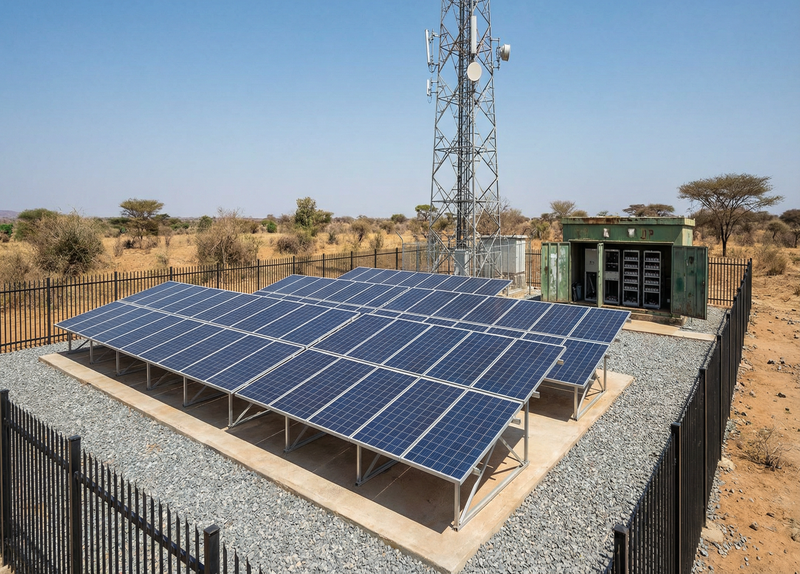
1. Aggressive Solar IntegrationSolar power must become the primary energy source for new 5G sites, particularly the numerous small cells required for urban densification. Designing sites with integrated solar PV systems from day one ensures that the increased power load is met with clean, renewable energy.
2. High-Density Energy StorageBecause 5G sites draw more power, they require more robust energy storage solutions. The transition from traditional lead-acid batteries to advanced Lithium-ion (Li-ion) technology is critical. Li-ion batteries offer higher energy density, faster charging times, and longer lifespans, making them ideal for handling the fluctuating power demands of 5G equipment.
3. Intelligent Energy ManagementDeploying smart site management systems that utilize artificial intelligence (AI) to optimize energy usage. These systems can dynamically shift power loads, prioritize solar energy during peak generation hours, and intelligently manage battery charging cycles to maximize efficiency.
At Vesselnet, we understand that 5G is as much an energy challenge as it is a telecommunications challenge. Through our POWER and DEPLOY pillars, we are uniquely positioned to support operators in this transition.
We provide integrated solutions that combine rapid, precision deployment of 5G infrastructure with robust, high-capacity solar and hybrid power systems. By engineering sites that are both technologically advanced and energy-efficient, Vesselnet is helping to build the sustainable backbone required to turn Nigeria's 5G ambitions into reality.
Vesselnet delivers integrated solutions that power network connectivity, from rapid network deployment to sustainable energy and intelligent access site control solutions.

Your Reliable Partner
Delivering reliable telecom infrastructure, sustainable energy, and network solutions across Nigeria and Africa.


.png)
.png)
.png)
.png)